And the more work you have a series circuit do the more your current will decrease. All pairs of loads in the circuit are in series.
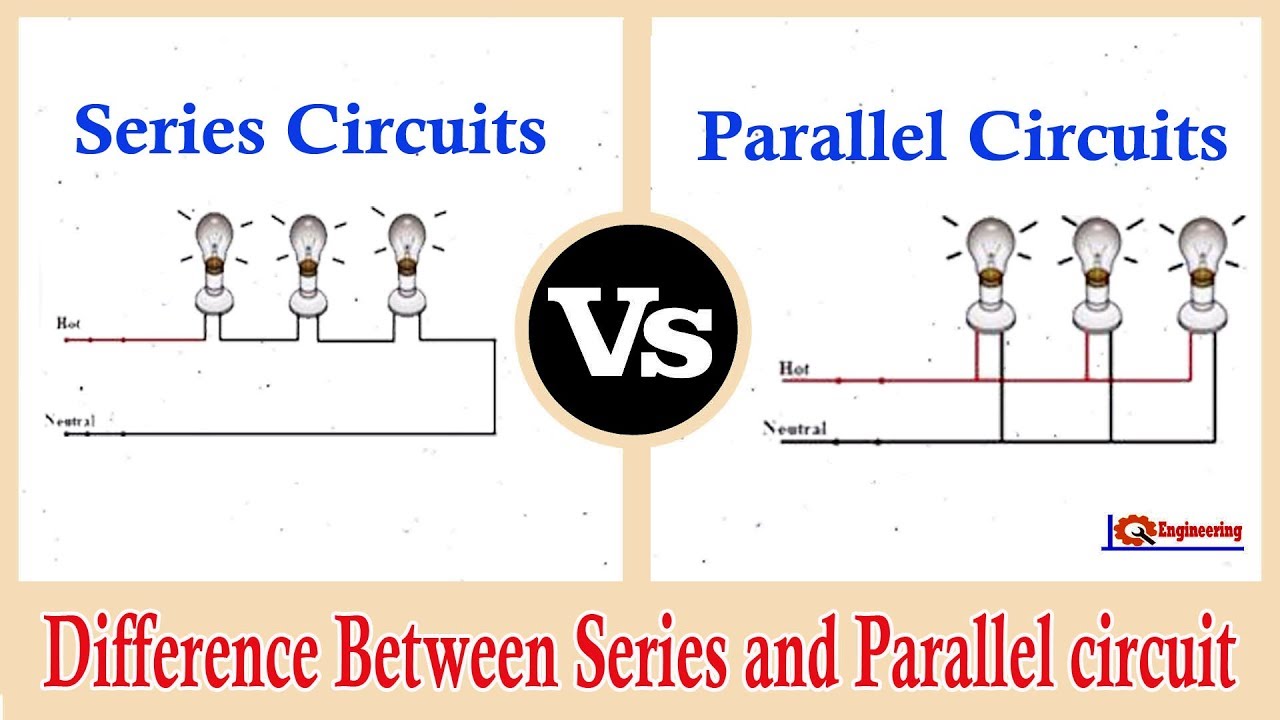
Series And Parallel Circuits Series Vs Parallel Difference Between S Series And Parallel Circuits Circuit Series
Parallel circuits are a bit trickier allowing multiple circuits to connect while operating individually as part of a larger circuit.

. It all depends if you want more or less current. Explanation of series and parallel circuits and the differences between each. Series circuit more resistance.
In a series circuit the more light bulbs that are added the more dim the light bulbs will shine. Also references Ohms Law and the calculation of total resistance in each type. In a television series you get several episodes one after the other.
Manipulate the numbers by plugging in the variables and find your answer. The voltage between each of the components is equal to the total voltage in a parallel circuit while in a series circuit the current through each of the components is equal to the total current. A series circuit offers the current of electricity one ideal path through the maze.
This means that in a parallel circuit the components are arranged side by side. The current going through. In a parallel circuit the current has to pass through at least two different branches.
In the simplest possible terms. Parallel circuit less resistance. Circuits wired in series are the easiest to understand with current flowing in one continuous smooth direction.
There are no parallel loads in the circuit. In a series circuit the resistors are arranged in a chain along one branch. If there are no branches then its a series circuit.
These types of circuits are deemed parallel because the branching path of the current runs alongside itself as it passes. Series and Parallel Circuits Series Circuit. In a parallel circuit the current splits into two or more paths to do work and then comes back together to go back to the battery.
All pairs of loads in the circuit are in parallel. Parallel refers to lines that run alongside each other. Also if anyone of the those light bulbs are disconnected or broken all other bulbs on that circuit will no longer function.
If we look at Ohms law and differentiate between parallel circuit and series circuit by resistance we should answer your question. In a series circuit all the components are arranged in a single line or a single path. In a parallel circuit the components are parallel to each other.
In a circuit a series is like a string of current that goes one by one through different components like lights motors buzzers etc. In a series circuit the voltage between the nodes of each element depends on the resistance or impedance of the circuit. There are no series loads in.
In a parallel circuit the voltage across each of the components is the same and the total current is the sum of the currents flowing through each component. If there are branches its a parallel circuit. In a series circuit the current that flows through each of the components is the same and the voltage across the circuit is the sum of the individual voltage drops across each component.
In a parallel circuit the bulbs will not dime even if many bulbs are added however there will be a larger current draw the more. Parallel circuits on the other hand are configured so that there are two or more paths through the circuit for the current to follow. Ohms law i vr.
Think of a set of light bulbs.

Series Vs Parallel Circuit Google Search Series And Parallel Circuits Science Lessons Science Electricity

Series Circuit And Parallel Circuit Switch On Diagram Stock Vector Illustration Of Circuit Bulb 207180508 Circuit Parallel Series And Parallel Circuits

Series And Parallel Circuits In Series Are Connected Along A Single Path So Series And Parallel Circuits Simple Electric Circuit Basic Electrical Engineering
Parallel And Series Circuits Bing Images Series And Parallel Circuits Fun Science Physics And Mathematics